


Office.
12B/18 Groves Ave.
Mulgrave, NSW
Australia.
Tel: (02) 8806 3557
Em: info@sydneyict.net.au
Web: sydneyict.net.au

Artificial intelligence is no longer just an emerging technology. Across industries, businesses are beginning to integrate AI into everyday operations, from productivity tools to analytics platforms and customer service systems.
Many organisations experimenting with AI today are still in the early stages. Teams may use AI assistants for writing or research, but the technology often sits alongside existing processes rather than being integrated into them.
Real productivity gains usually appear when AI is connected to everyday workflows, helping teams reduce repetitive work and move information between systems automatically.
The difference usually comes down to implementation. Businesses that see real results focus less on chasing the latest AI tool and more on embedding artificial intelligence into workflows that streamline operations and support better decision-making.
For growing organisations and small business owners, this shift can unlock significant opportunities. When used effectively, AI for business helps teams save time, improve efficiency and scale operations without dramatically increasing workload.
Quick links:
Understanding the benefits of AI in business helps clarify why organisations are investing in these technologies. While AI is often associated with automation or content generation, its real value lies in improving how businesses operate.
One of the most immediate benefits of AI is improved productivity.
Tools such as AI assistants can help teams draft documents, summarise meetings, analyse information and generate action items in real time.
These capabilities reduce administrative overhead and allow employees to focus on higher-value work.
Many businesses collect large amounts of data but struggle to extract meaningful insights from it.
AI analytics tools can process operational data and highlight patterns, trends and anomalies that may otherwise go unnoticed.
By providing insights in real time, AI supports faster and more informed decision-making.
AI can also improve how businesses interact with customers.
From analysing enquiries to assisting with customer support responses, AI helps teams respond faster while maintaining service quality.
Rather than replacing staff, AI supports them by reducing repetitive work and allowing more time for meaningful customer interactions.
Perhaps the most powerful benefit of AI is scalability.
By automating repetitive processes and streamlining workflows, businesses can handle greater operational complexity without increasing workload at the same pace.
This is where AI for business growth begins to deliver long-term value.
One common misconception is that adopting AI requires implementing entirely new platforms. In reality, many organisations already have artificial intelligence embedded within the systems they use every day.
Modern productivity platforms such as Microsoft 365, analytics dashboards and automation platforms increasingly include built-in AI capabilities.
In many cases, the organisations we speak with are already paying for tools that include AI features but have not yet incorporated them into their workflows.
Rather than introducing completely new systems, many organisations see the greatest value by improving and integrating the tools they already rely on.

Businesses often think about AI as a technology investment, but it is most effective when applied to specific operational challenges.
Some of the most common opportunities for AI for business growth include:
Individually, these improvements may seem incremental. Together, they can dramatically improve how efficiently a business operates.
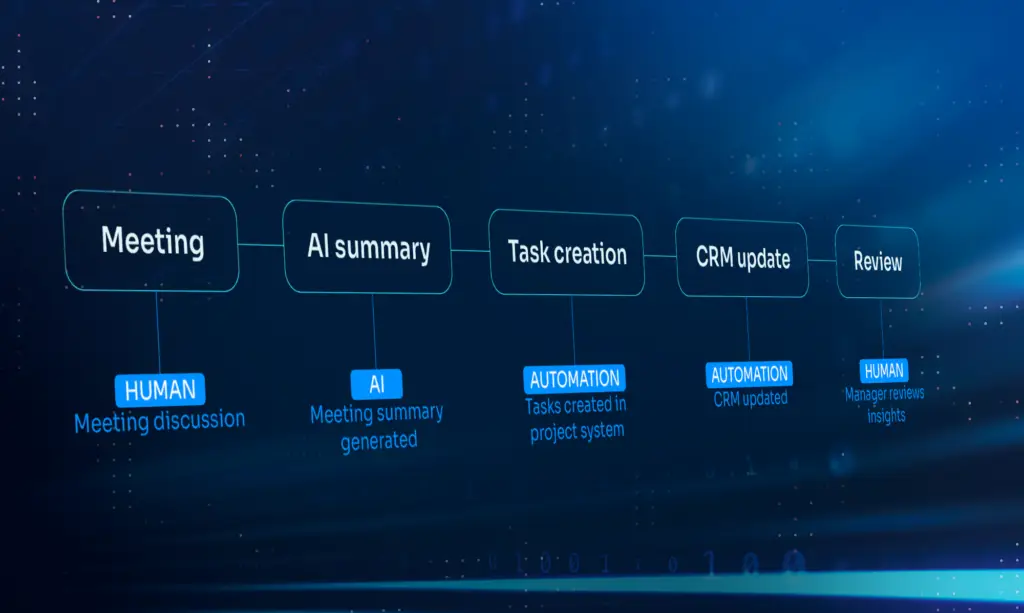
Successfully implementing AI for business requires more than simply adopting new tools. The organisations seeing the strongest results usually follow a structured approach.
Start by identifying areas where teams spend significant time on routine tasks. Reporting, documentation, marketing workflows and customer enquiries are common examples.
These areas are often ideal starting points for AI because improvements can quickly help teams save time.
In many cases, organisations see the greatest improvements not by introducing new tools, but by integrating AI into platforms they already use every day.
Many businesses already operate within established platforms such as collaboration tools, analytics dashboards or project management software. Rather than replacing these systems, AI can often be integrated to enhance their capabilities.
This allows organisations to unlock the benefits of AI in business without disrupting existing workflows.
The most powerful applications of AI occur when it is connected to automation workflows.
Instead of simply generating insights or content, AI can trigger operational processes such as creating action items, updating systems and routing information between platforms automatically.
This is where AI for business growth becomes truly transformative.
Technology alone does not deliver results.
Teams need to understand how AI can support their work and how to incorporate it into everyday processes.
Successful organisations treat AI as a capability that employees learn to work alongside, rather than as a tool that replaces human expertise.
Many organisations exploring AI for business growth eventually realise that the technology itself is not the biggest challenge.
The real challenge is designing workflows that make artificial intelligence genuinely useful in everyday operations.
Businesses that see the strongest results from AI typically focus on a few key principles:
When implemented correctly, AI becomes more than just another software tool. It becomes part of the operational infrastructure that supports the organisation.

One of the most common challenges businesses face with AI is moving beyond experimentation. Many teams test individual tools but struggle to connect those tools into workflows that support everyday operations. When implemented strategically, AI becomes part of the operational infrastructure that supports productivity, decision-making and long-term growth.
Turning AI into a real productivity advantage often requires more than simply adopting new tools. It involves identifying where AI can streamline operations, designing workflows and implementing the integrations that support those processes.
If you’re exploring where to begin, you may find our guide toAI tools for business helpful. It breaks down the categories of tools that can streamline workflows and support everyday operations.
We work with businesses to design and implement AI-driven workflows using platforms such as Copilot, Power Apps and automation tools to deliver practical productivity improvements.
If you’re looking to unlock the real benefits of AI in business and streamline your operations for growth, get in touch with our team and let’s start building a smarter way for your business to work.
Automation & AI Business Solutions
Last updated: September 2026 If you've recently signed into Microsoft 365 and been prompted to "set up a passkey,"...

Artificial intelligence is no longer something only large enterprises are thinking about. Small and medium businesses...

Artificial intelligence is now part of everyday business. Teams are using AI to draft emails, summarise documents,...

0 Comments