


Office.
12B/18 Groves Ave.
Mulgrave, NSW
Australia.
Tel: (02) 8806 3557
Em: info@sydneyict.net.au
Web: sydneyict.net.au

Artificial intelligence is no longer something only large enterprises are thinking about. Small and medium businesses are already using AI to write emails, summarise meetings, generate content, analyse data, improve customer service, automate admin tasks and support decision-making.
The opportunity is significant. AI can help teams save time, reduce repetitive work and improve how they operate day-to-day. But without the right structure, AI can also create new risks around privacy, cybersecurity, accuracy, compliance, staff behaviour and customer trust. This is where AI governance becomes important.
For many SMEs, the phrase ‘AI governance’ can sound overly corporate or technical. It may bring to mind large committees, complex frameworks and enterprise-level compliance programs. In reality, AI governance does not need to be complicated.
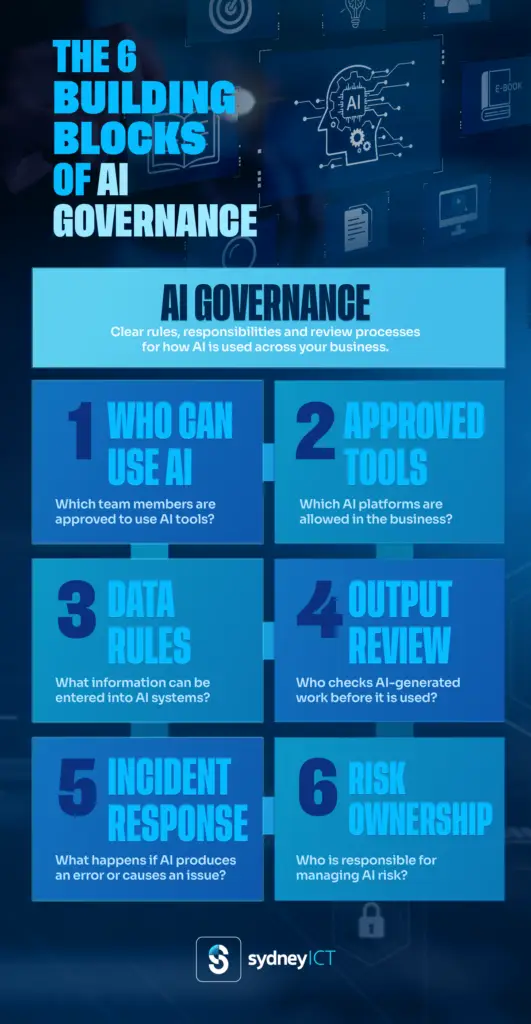
At its simplest, AI governance means having clear rules, responsibilities and review processes for how AI is used across your business.
It helps answer practical questions such as:
AI governance is not about slowing your business down. It is about making AI safe enough, trusted enough and structured enough to use properly.
Many businesses start using AI informally. A staff member tries ChatGPT to rewrite an email. Another uses an AI meeting assistant. A manager uses AI to summarise a report. A marketing team uses AI to create content ideas. Someone connects an AI tool to their inbox, CRM or file storage.
Individually, these uses may seem harmless. Collectively, they can create risk if the business does not know what tools are being used, what information is being entered, or whether the outputs are being checked.
The issue is not that staff are trying to do the wrong thing. Most of the time, they are simply trying to work more efficiently. The problem is that AI adoption often happens faster than AIsecurity, policy and training can keep up.
Without governance, businesses may face issues such as confidential information being entered into public AI tools, inaccurate AI-generated advice being sent to customers, staff relying on hallucinated information, unapproved tools being connected to business systems, or AI automations taking actions without enough oversight.
Good AI governance helps prevent these risks while still allowing thebusiness to benefit from AI.
The first step is understanding where AI is already being used in the business.
This includes obvious tools such as ChatGPT, Microsoft Copilot, Gemini, Claude and AI-powered CRMs. It also includes less obvious AI features inside platforms your business may already use, such as email tools, design software, helpdesk platforms, accounting systems, meeting recorders, browser extensions and automation platforms.
A simple AI register is one of the most practical governance tools an SME can create.
This register should list:
This does not need to be a complex compliance document. It just gives the business visibility. Once you know what AI tools are being used, you can make better decisions about what should be approved, restricted, reviewed or replaced.
Data is one of the biggest areas of risk in AI use. Staff need to understand what information can and cannot be entered into AI tools. Without clear guidance, they may paste in customer details, contracts, financial records, internal documents, HR information, passwords, system configurations or commercially sensitive information without realising the risk.
A practical AI governance approach should include a simple data-use policy.
This might separate information into categories:
The policy should make it clear when approval is required and what should never be entered into public or unapproved AI tools. For SMEs, this is one of the most important parts of AI governance because it gives staff confidence. They do not need to guess what is acceptable.
AI governance needs accountability. That does not mean every SME needs a dedicated AI officer or committee. But someone needs to be responsible for approving tools, setting expectations and reviewing risk.
Depending on your business, this responsibility may sit with the owner, general manager, IT manager, operations manager, cybersecurity provider or leadership team. The important thing is that AI is not left unmanaged.
Businesses should decide:
When ownership is clear, AI becomes easier to manage. When ownership is unclear, AI use becomes fragmented and inconsistent.
Not every AI use case needs the same level of control. Using AI to brainstorm internal social media ideas is very different from using AI to assess job applicants, generate financial advice, support customer service, review contracts or automate business processes.
A useful governance principle is to match the level of control to the level of risk.
There is a major difference between AI that helps draft a response and AI that can take action on behalf of the business. If AI can send emails, update records, create tickets, process requests or trigger workflows, the business needs stronger controls.
Those controls may include human approval steps, access limits, testing, audit logs, error handling, rollback plans and clear boundaries around what the automation can and cannot do.
The safest approach is not always to remove humans from the process entirely. Often, the best approach is to use AI to reduce manual work while keeping people involved at the right decision points.
AI can produce useful outputs quickly, but it can also be confidently wrong. AI-generated content can contain errors, missing context, outdated information or invented details. This is especially risky when the output is used for customer communication, legal matters, financial decisions, HR issues, compliance, technical support or cybersecurity.
AI governance should define when human review is required. A simple rule is: the greater the impact of the AI output, the stronger the review process should be.
For example, a staff member using AI to tidy up internal notes may not need formal review. A team member using AI to draft a client-facing proposal should check the output carefully. AI-generated legal, financial, HR or security-related material should be reviewed by someone suitably qualified before it is relied upon.
This protects the business while still allowing staff to use AI productively.
Many SMEs will use AI through third-party platforms. That makes vendor review an important part of AI governance. Before approving an AI tool, businesses should ask practical questions:
These questions help determine whether the tool is suitable for business use, especially where sensitive data or system access is involved. A tool may be useful, but that does not automatically mean it is safe to connect to your business environment.
AI governance only works if staff understand it. A policy sitting in a folder is not enough. Staff need practical training on how AI can be used, what data should be protected, how to check outputs, what tools are approved and where to ask questions.
Training should be simple, relevant and role-specific.
For example, the marketing team may need guidance on reviewing AI-generated content. The admin team may need rules for meeting notes and email drafting. The sales team may need guidance on proposals and customer information. The technical team may need rules around code, credentials and system documentation.
The aim is not to overwhelm staff. It is to give them enough clarity to use AI confidently and safely.

AI tools change quickly. Business use cases also change quickly.
That means AI governance should not be treated as a one-off project. It should be reviewed regularly as new tools are introduced, vendor terms change, staff behaviour evolves and AI becomes more embedded in workflows.
A good SME approach might include a quarterly review of the AI register, approved tools, staff feedback, incidents, automation workflows and any new risks.
This keeps governance practical and alive, rather than becoming a document that is created once and forgotten.
The businesses that get the most value from AI will not be the ones that let everyone use anything without structure. They will be the ones that create clear, practical guardrails so staff can use AI safely and confidently.
AI governance gives SMEs a way to adopt AI without creating unnecessary risk. It provides visibility, protects data, supports better decision-making, improves staff consistency, reduces cybersecurity exposure and helps customers trust how AI is being used.
Sydney ICT helps businesses turn those principles into practical systems. From identifying AI opportunities and secure Microsoft 365 configuration through to automation design and cybersecurity controls, ourAI & Automation specialists can help your business adopt AI in a way that is secure, practical and built for real-world operations.
Get in touch with our team to discuss how we can help your business implement AI safely and effectively.
Last updated: September 2026 If you've recently signed into Microsoft 365 and been prompted to "set up a passkey,"...

Artificial intelligence is now part of everyday business. Teams are using AI to draft emails, summarise documents,...

Artificial intelligence and automation are no longer future concepts. For many businesses, they’re already part of...

0 Comments