


Office.
12B/18 Groves Ave.
Mulgrave, NSW
Australia.
Tel: (02) 8806 3557
Em: info@sydneyict.net.au
Web: sydneyict.net.au

Artificial intelligence and automation are no longer future concepts. For many businesses, they’re already part of everyday tools and systems. But despite this, a large number of organisations still rely heavily on manual and repetitive processes to keep operations moving.
However, without solid workflows, manual processes can lead to time-consuming admin, inconsistency, unnecessary delays or missed follow-ups.
This is where business automation creates real value for businesses of all sizes.
When implemented properly, automation doesn’t just save time. It helps businesses increase efficiency, improve consistency and reduce errors, while giving teams more capacity to focus on meaningful work.
In this guide, we’ll break down what business automation really means, the benefits of automation in business, and 10 practical areas where ai business automation and business process automation can make an immediate impact.
At its core, business automation is the process of designing systems that allow work to move through your business without constant manual input.
Rather than relying on team members to complete every step, automation uses technology to handle repetitive tasks, decision points and handovers between systems and people.
Instead of work being managed manually, an automation system allows processes to run automatically based on defined triggers and conditions.
Traditional automation is typically rules-based, meaning it follows predefined logic. With the addition of AI, businesses can now move beyond simple rules into systems that:
When combined, they create workflows that are both structured and intelligent, allowing businesses to operate more efficiently while still handling real-world complexity.
The advantages of business process automation are often described in simple terms like saving time or reducing workload. However, this is only scratching the surface.
When implemented correctly, the impact is felt across the entire business.
By removing repetitive tasks, team members can focus on higher-value work instead of admin.
Automated processes reduce time spent on manual handovers, follow-ups and data entry.
Automation software ensures processes are followed the same way every time, reducing human error.
Less manual work means fewer inefficiencies, helping businesses reduce costs over time.
Faster responses, better follow-up and consistent communication all contribute to stronger customer outcomes.
With automation systems in place, businesses can access data and insights in real time, rather than waiting for reports.
The result isn’t just faster work, it’s better-structured work, supported by systems that are designed to perform reliably every day.
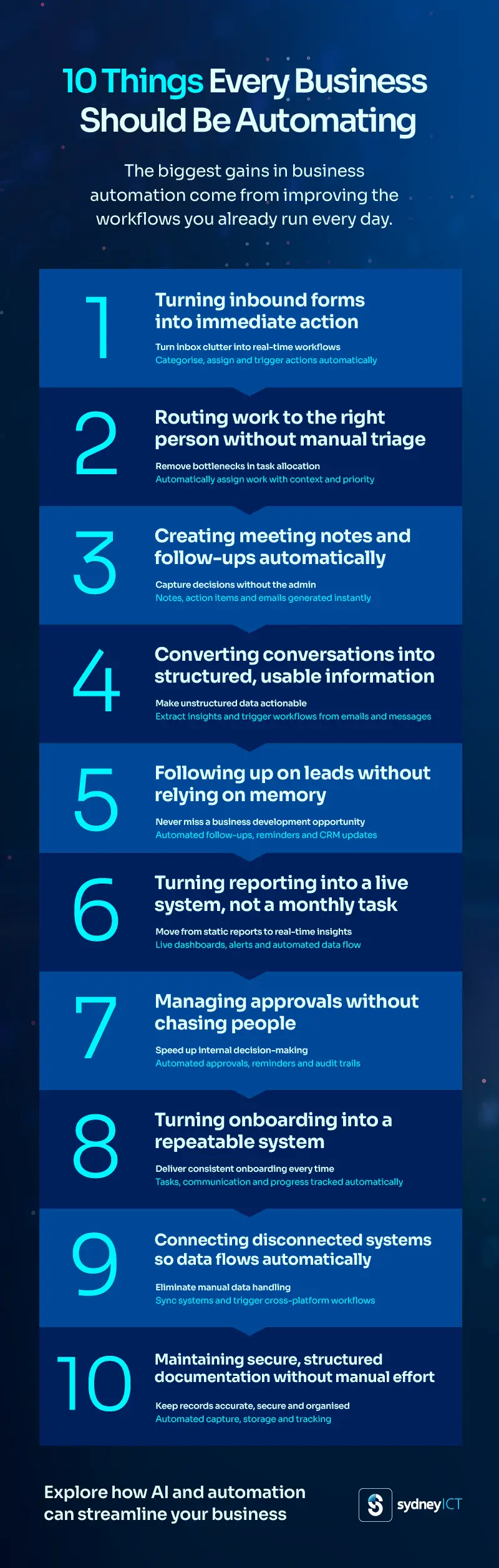
The biggest gains in business process automation don’t come from adding more tools. They come from improving the workflows your business already runs every day.
Most businesses already have forms in place, whether for enquiries, internal requests or operational checks. The issue is what happens next.
Typically, form submissions sit in an inbox until someone has time to review them. A team member reads the response, decides what it means, forwards it to the right person and follows up if needed. This creates delays, inconsistency and a reliance on manual handling.
With business automation, this entire process can be redesigned. Instead of sitting in an inbox, a submission becomes the start of a workflow:
For example, we’ve recently built an automation for a client that flags certain responses for a staff form and automatically creates a notification for the supervisor to review as a priority.
The result is a process that moves in real time, not one that depends on someone checking an inbox. While this is a relatively simple shift, it can dramatically increase efficiency, reduce delays and ensure nothing gets missed.
A surprising amount of operational friction comes from determining who should be handling a task.
In many businesses, tasks are manually assigned after someone reviews the request. This creates delays, inconsistent allocation and unnecessary back-and-forth between team members.
With business process automation, this decision-making step can be built into the workflow itself.
Instead of relying on manual triage:
For example, the Sydney ICT service desk utilises a custom AI agent to review support requests, determine which technician should handle them and generate a summary of the issue, along with suggested troubleshooting paths based on our internal knowledgebase.
This removes bottlenecks, ensures faster response times and creates consistency across how work is distributed.
Meetings are where decisions are made, but they’re also where information is often lost.
In many businesses, someone is responsible for taking notes, summarising discussions and sending follow-up emails. This is not only time-consuming, but it’s also inconsistent. Important actions can be missed, and follow-ups depend on individuals rather than systems.
With AI automation for business, meetings can become structured, repeatable workflows.
Instead of relying on manual effort:
For example, we’ve built an AI agent that integrates with Microsoft 365 to capture Teams meeting transcripts, generate structured meeting summaries and draft post-meeting follow-up emails for participants, making note-taking and follow-up significantly more streamlined.
It also means that every meeting produces a clear outcome without additional admin work.
More importantly, it ensures accountability. Tasks are tracked, decisions are recorded, and everyone involved has the same visibility.
What was previously a manual, time-consuming process becomes a consistent and reliable system that supports the team.
Every business generates large volumes of information through emails, messages and support conversations. The challenge is that most of this information is never structured or stored in a way that makes it useful. Instead, it sits in inboxes, chat threads or ticket histories.
Rather than relying on manual documentation:
For example, a customer email describing an issue can be analysed, categorised and converted into a structured task without someone manually rewriting it.
This reduces manual handling, improves data quality and ensures important information is captured and acted on consistently.
Lead management often breaks down not at the point of enquiry, but in the follow-up.
Many businesses rely on team members to remember to respond, follow up and check in on leads. This leads to missed opportunities and inconsistent customer experiences, especially when you factor in sick leave and personnel changes.
With automation solutions, follow-up becomes part of a structured workflow:
For example, instead of relying on someone to remember to follow up in three days, the system ensures it happens automatically.
Within HubSpot, you can already create tasks for deals and contacts. We enhanced this framework by integrating an AI agent to review recent meetings and prompt internal staff to create a follow-up task (along with a suggested task timeframe). As this is using a chat framework for the prompts, staff can also reply to change task specifics (such as the timeframe).
Not only does this provide more flexibility than a static workflow, but it also works more intelligently, recognising when a follow-up task already exists so staffaren’t prompted unnecessarily.
Reporting is one of the most common examples of work that feels necessary but inefficient.
Many businesses still rely on manual reporting processes to export data, build spreadsheets, summarise results and send reports.
With the right automation system, reporting can become continuous rather than periodic so that information stays up to date.
Instead of manually building reports:
For example, instead of waiting until the end of the month to identify a drop in performance, the system can flag it immediately and notify the relevant team.
We’ve created a dashboard for The SIL Company that pulls data from a client’s NDIS funding plan, compares it against scheduled roster hours and highlights variances between funded supports and allocated staffing.
The result is faster responses, better insights and significantly less time spent on manual data handling.
Approval processes are often one of the biggest sources of delay in a business.
Whether it’s expenses, purchase orders or internal sign-offs, the process typically involves sending emails, waiting for responses, following up manually.
Utilising automation software, approvals can be built into a structured workflow where AI can also assist by:
For example, we built an integration for emails received by accounts@ for staff reimbursements to automatically pipe into the Xero software so they are ready to be approved and included in the payroll weekly.
The result is a faster, more transparent process with clear accountability and less manual work.
Onboarding is critical, but often inconsistent. Whether it’s bringing on a new client or onboarding a new team member, many businesses rely on informal processes and manual coordination.
This can lead to missed steps, delays and inconsistent experiences. However, when automated, onboarding becomes structured and consistent.
For example, we built a system for our client in the construction industry to meet compliance regulations while reducing manual handling. For each new project, workers scan a QR code on their first day and complete a form which automatically generates key compliance documentation for project supervisors to access and present to high-level stakeholders.
This ensures a consistent experience, reduces administrative overhead and improves overall efficiency.
Most businesses operate across multiple systems:
But these systems often don’t communicate effectively, creating duplication and manual data entry.
With business process automation solutions, these systems can be connected into a single workflow.
Instead of manually transferring data, an automation solution can connect these into a single workflow.
For example, we worked with Raymax Lasers to automate the generation of custom job IDs across HubSpot and Xero. Whenever a new deal is created in HubSpot, the integration automatically generates the next sequential job ID, removing the need for manual input while supporting the business’s existing workflow.
This is where integration and automation deliver significant gains, allowing your business to operate as a connected system rather than a collection of separate tools. Read how we delivered this solution for Raymax Lasers.
Managing business data securely and consistently is essential, but often handled through fragmented and manual processes.
Documents may be stored in various locations, updated sporadically, and difficult to track or audit. However, with automation and AI, documentation can become part of the workflow itself.
Instead of relying on manual handling:
This ensures your business maintains data-secure documentation, improves data integrity and reduces the risk associated with manual handling.
Part of the approach we have taken with all of our automation development is to build strong guardrails for AI. For example, we’ve built guardrails for our AI assistants to have least privilege access to our data and to not share sensitive data between staff members. This adds an additional layer of protection that helps reduce the risk of sensitive documentation and data being exposed internally or externally.
For most businesses, the challenge isn’t understanding what business automation is, it’s knowing where to begin.
The temptation is often to jump straight into tools. But as we’ve explored throughout this guide and our broader content onAI for business growth, the real value comes from improving workflows, not just introducing new technology.
A more effective starting point is to look at how work currently moves through your business.
Start by identifying areas where:
These are the processes whereautomation and AI can deliver the greatest impact.

Many businesses understand the potential of automation but struggle with the practical side of implementing it.
The challenge isn’t finding the rightautomation tools. It’s designing workflows that actually work across your business.
We help organisations buildAI & automation business solutions that reduce manual processes, connect systems and deliver real operational improvements.
If you’re looking to move beyond disconnected tools and create an automation system that supports your business as it grows, get in touch with our team or let’s chat about how AI & automation can best integrate with your business operations.
Explore our Automation & AI Business Solutions
Last updated: September 2026 If you've recently signed into Microsoft 365 and been prompted to "set up a passkey,"...

Artificial intelligence is no longer something only large enterprises are thinking about. Small and medium businesses...

Artificial intelligence is now part of everyday business. Teams are using AI to draft emails, summarise documents,...

0 Comments