
















Office.
12B/18 Groves Ave.
Mulgrave, NSW
Australia.
Tel: (02) 8806 3557
Em: info@sydneyict.net.au
Web: sydneyict.net.au

Artificial intelligence is everywhere right now. From productivity apps to marketing platforms, it seems like every new product promises to transform the way we work.
But for many organisations exploring AI tools for business, the experience can quickly become overwhelming.
Many of the tools appearing in advertisements promise to automate entire workflows with a simple subscription. While these platforms can be useful, meaningful productivity improvements rarely come from a single standalone tool.
The capabilities AI promises are real, but they typically require thoughtful integration with existing systems and workflows rather than relying on a single “$30 AI subscription” to solve complex operational problems.
The businesses seeing the strongest results from artificial intelligence are not simply installing new tools. They are embedding AI into everyday workflows, so it genuinely supports the way teams operate.
Instead of reviewing dozens of apps, this guide focuses on the categories of tools for business that actually improve productivity, along with practical guidance on how organisations can start using them effectively.
Quick links:
What makes an AI tool valuable for a business?
Where most businesses go wrong
Turn AI into a real productivity advantage
Not every AI tool creates a meaningful impact. Many platforms demonstrate impressive capabilities but fail to improve real business workflows.
The most useful AI productivity tools tend to share a few characteristics.
They help teams save time, reduce repetitive work and streamline administrative tasks. They integrate with existing systems such as communication platforms, analytics dashboards or project management software. And they support better decision-making by analysing information and generating insights.
For small business owners, this is especially important. Rather than investing in complex systems, AI for small businesses often delivers the most value when it improves everyday operational tasks.
One of the biggest misconceptions surrounding AI tools for business is the belief that productivity gains come from installing the right app.
Many platforms demonstrate impressive capabilities in isolation. A tool may generate reports, summarise conversations or automate a task with a single prompt. These demonstrations can make it appear as though the tool alone will transform how a business operates.
In practice, however, most organisations quickly discover that the tool still sits outside their existing workflows. Staff may generate useful information, but they still need to move that information between systems, verify outputs and manually coordinate the next steps.
This creates what could be called the AI tool illusion. The technology works, but the promised productivity gains never fully materialise because the tool has not been integrated into the organisation’s operational processes.
Businesses that see real value from AI approach the problem differently. Instead of asking “What tool should we install?” they ask “Where in our workflow could AI remove friction?”
Once the workflow is understood, the tools become far easier to select and implement effectively.
In reality, the biggest improvements occur when AI becomes part of operational workflows.
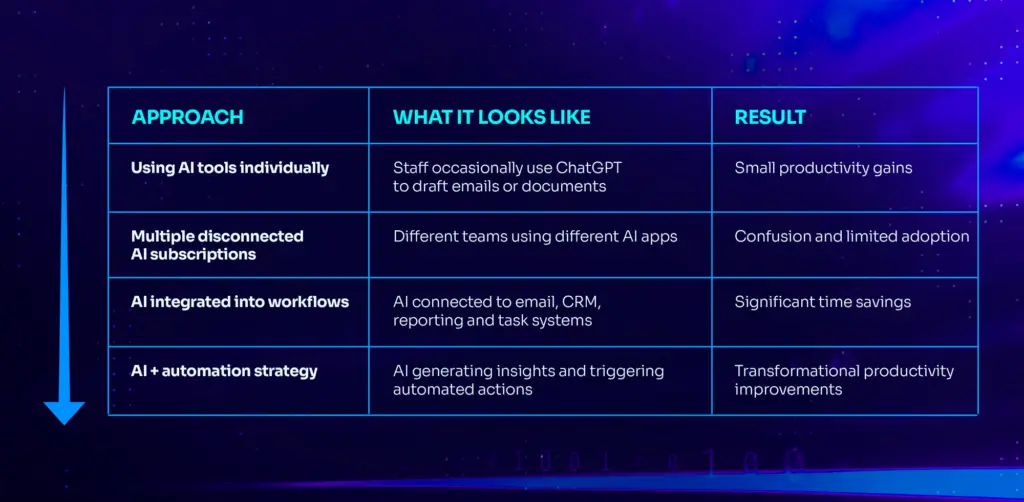
The tools themselves often remain the same. What changes is how AI is integrated into the organisation.
The rapid growth of generative AI has produced a huge range of new platforms and applications. However, when you look past the hype, most AI tools for small teams and larger organisations alike fall into a handful of categories that deliver real operational value.
These categories focus on areas where artificial intelligence can support everyday workflows, such as improving AI productivity, streamlining customer support and helping teams manage information more effectively. Understanding these categories makes it easier to choose tools for business that genuinely improve how work gets done.
Many teams spend a large portion of their day on administrative work. Writing emails, summarising meetings, organising documentation and preparing reports all consume valuable time.
These repetitive tasks rarely add strategic value, yet they are essential to daily operations.
AI assistants can reduce this administrative workload by helping generate text, summarise information and organise documentation automatically. Modern generative AI systems can analyse conversations, extract insights and even identify action items in real time.
In practice, productivity AI tools deliver the most value when they are introduced as workflow assistants rather than writing tools.
Instead of simply encouraging staff to “use AI more”, identify the points in your workflow where AI can remove friction. Meeting documentation, internal updates and reporting summaries are often ideal starting points because they are repetitive tasks that consume valuable time.
Used this way, AI helps teams save time on administrative work without replacing the expertise and decision-making that people bring to their roles.
Examples of productivity-focused AI tools include:
Microsoft Copilot is one of the most practical AI assistants available today.
Rather than introducing a new platform, Copilot embeds generative AI directly inside tools teams already use, such as Outlook, Word, Excel and Teams.
This allows staff to generate meeting summaries, draft emails, analyse documents and extract action items in real time, making it easier to streamline everyday workflows.
Common uses of productivity AI tools include:
When implemented effectively, these tools can significantly reduce the administrative burden across teams.
Instead of spending hours documenting discussions or preparing reports, employees can focus on more strategic work while AI handles routine tasks.
Many organisations waste significant time moving information between systems. Staff manually transfer data between email platforms, CRM systems, reporting dashboards and project management tools.
These small tasks add up quickly and often create operational friction across the business.
Even when companies adopt AI tools for business, they frequently remain isolated from the rest of the workflow. AI might generate insights or summaries, but staff still need to manually move that information into other systems.
Workflow automation platforms solve this problem by connecting different applications together.
They allow businesses to design processes where information flows automatically between systems. When combined with artificial intelligence, these workflows can interpret information, trigger actions and update systems in real time.
Automation tools like n8n deliver the most value when businesses focus on workflow design rather than individual automations.
This is where AI moves beyond assisting with tasks and begins supporting end-to-end operational workflows.
Examples of automation tools include:
Among modern automation platforms, we’re particularly excited by the capabilities that n8n and Power Automate offer when used together to build AI-driven workflows.
While each platform is powerful on its own, combining them allows businesses to design more flexible and scalable automation systems.
n8n provides a highly customisable environment for building complex workflows, connecting multiple systems and processing data in sophisticated ways. It acts as an orchestration layer, allowing organisations to define how information moves between tools and how decisions are triggered.
Power Automate complements this by integrating seamlessly with Microsoft 365 and enterprise systems, making it easier to embed automation into everyday business operations.
Together, these platforms allow businesses to design workflows where AI interprets information, automation executes processes and systems remain fully connected.
For example, we’ve recently implemented an AI workflow for a client using Power Automate and n8n that allows on-site staff to submit checks through a Microsoft Form while in the field. If certain responses are flagged as “yes” or “unsure”, the system automatically creates a Jira ticket with all relevant information and escalates the issue to the appropriate team leaders.
This ensures the right people are notified immediately, with full context, enabling faster review and follow-up without manual intervention.
Automation platforms like n8n and Power Automate can support workflows such as:
When automation and AI are combined effectively, businesses can dramatically reduce administrative overhead and improve operational efficiency.
Instead of manually coordinating systems, organisations can create workflows where AI interprets information and automation ensures the right actions happen automatically.
This not only reduces repetitive work, but also improves consistency, response times and visibility across operations.
As a result, teams can spend less time managing processes and more time focusing on decision-making, service delivery and growth.
Most organisations collect large volumes of operational data but struggle to convert that information into actionable insights.
Manual reporting processes can be time-consuming and difficult to maintain.
AI-powered analytics tools can analyse large datasets, identify patterns and generate insights automatically.
Many of these systems provide insights in real time, allowing businesses to respond faster to trends and operational changes.
AI becomes most valuable when it helps organisations understand their data faster and supports more informed decision-making.
Examples include:
For organisations already using Microsoft systems, Microsoft Power BI is one of the most powerful tools available for AI-driven analytics.
Power BI can analyse data, generate summaries and surface insights quickly, helping teams interpret operational information more effectively.
Typical uses include:
AI-driven analytics transforms reporting from a manual process into a decision-support system that helps leaders make faster, more informed decisions.
Many organisations receive large volumes of routine enquiries that require simple responses. Handling these requests manually can place significant pressure on support teams.
This can lead to slower response times and increased operational workload.
AI-driven support tools can help manage enquiries by analysing requests, routing tickets and drafting responses.
The best implementations use AI to summarise requests, categorise enquiries and draft responses so that support teams understand and respond to issues quickly. This allows human support staff to focus more on complex problems and customer relationships.
Examples of AI-powered customer support tools include:
For organisations managing high volumes of enquiries, Jira Service Desk integrates AI capabilities directly into the support workflow.
Through ‘Ask Rovo’, the platform can summarise conversations, recommend responses and route enquiries to the correct team automatically. Combined with built-in automation features, it helps streamline support processes and ensures teams can respond to requests more efficiently.
Out-of-the-box AI features can significantly improve support workflows, but the real value comes from extending these capabilities through integration and automation.
For example, we’ve implemented n8n workflows within Jira that automatically review incoming issues using AI to determine the likely problem and provide technicians with a clear summary before they begin work. These workflows can also highlight the most impactful troubleshooting steps first, helping teams resolve issues more efficiently.
By combining AI with automation platforms like n8n, support systems can move beyond reactive ticket handling and begin actively supporting teams with prioritisation, diagnosis and resolution.
Typical uses include:
AI support tools can dramatically improve response times while reducing the workload on support teams.
This leads to more efficient service delivery and a better customer experience.
Despite the growing availability of AI tools for small organisations and enterprises alike, many businesses struggle to see real results.
One common issue is adopting multiple tools without a clear strategy. Companies subscribe to several platforms but fail to integrate them into workflows. Quite often, this means more time is spent inputting information and requests to AI than is saved using it.
Another challenge is expecting AI to fully replace human tasks rather than support them. Understanding where AI can streamline workflows and support your staff can make all the difference than trying to use AI to replace entire roles.
Successful AI adoption requires thoughtful implementation and clear operational goals.

Many organisations experimenting with AI tools for business eventually realise that the technology itself is not the biggest challenge. The real challenge is designing workflows that make artificial intelligence genuinely useful in everyday operations.
Turning AI into a real productivity advantage typically involves:
When implemented correctly, AI becomes more than just another software tool. It becomes part of the operational infrastructure that supports the entire organisation.
The goal is not to replace people or remove expertise from the business. Instead, it is to remove friction, allowing teams to spend less time on administrative tasks and more time focusing on strategy, creativity and customer relationships.
Businesses that approach AI strategically, focusing on integration, workflow design and operational efficiency, are the ones most likely to unlock the true value of modern AI productivity technologies. Find out more about AI for business growth.
Many organisations understand the potential of AI but struggle with the practical side of integrating it into their systems.
We help businesses design and implement AI workflows using tools such as Copilot, Power Apps and automation platforms to deliver real productivity improvements.
Get in touch with our team today, and let’s start streamlining your business for growth.

Artificial intelligence is no longer just an emerging technology. Across industries, businesses are beginning to...

The working world has changed drastically over the last few years. Not only is productivity a priority, but...

In the ever-evolving landscape of technology, a proactive approach is your most powerful business tool. By...

0 Comments